
Client
Circuitry.ai
Team
VP Product, 20+ Engineers
Role
Product Design, System Architecture
Scope
Virtual Inspections, Tenant Management, Scoring Configuration, Access Control
TL;DR
As the sole designer supporting a large engineering team, I led the end-to-end design of a configurable inspection and scoring architecture that enforced system integrity across dynamic workflows, tenant configurations, and automation gates.
I translated ambiguous product inputs into governed, production-ready system models by:
- Designing adaptive inspection branching workflows
- Building hierarchical scoring architecture with 100% validation enforcement
- Separating scoring logic from automation triggers
- Introducing publish gating to prevent invalid configurations from reaching production
The result: A scalable configuration system that reduced ambiguity, prevented invalid deployments, and improved cross-functional alignment.

The Challenge
Circuitry.ai was building configurable inspection and scoring systems across multiple tenants and use cases.
The complexity included:
- Multiple inspection types (Standard, Safety, Emissions)
- Conditional branching based on reported failures
- Configurable scoring hierarchies with strict weighting rules
- Automation triggers based on thresholds (percentage, days, amount)
- Multi-tenant overrides and governance requirements
The risk was clear: Without structure, the system would become brittle, inconsistent, and difficult to scale.
We needed flexibility without sacrificing integrity.
Inspection Workflow Architecture
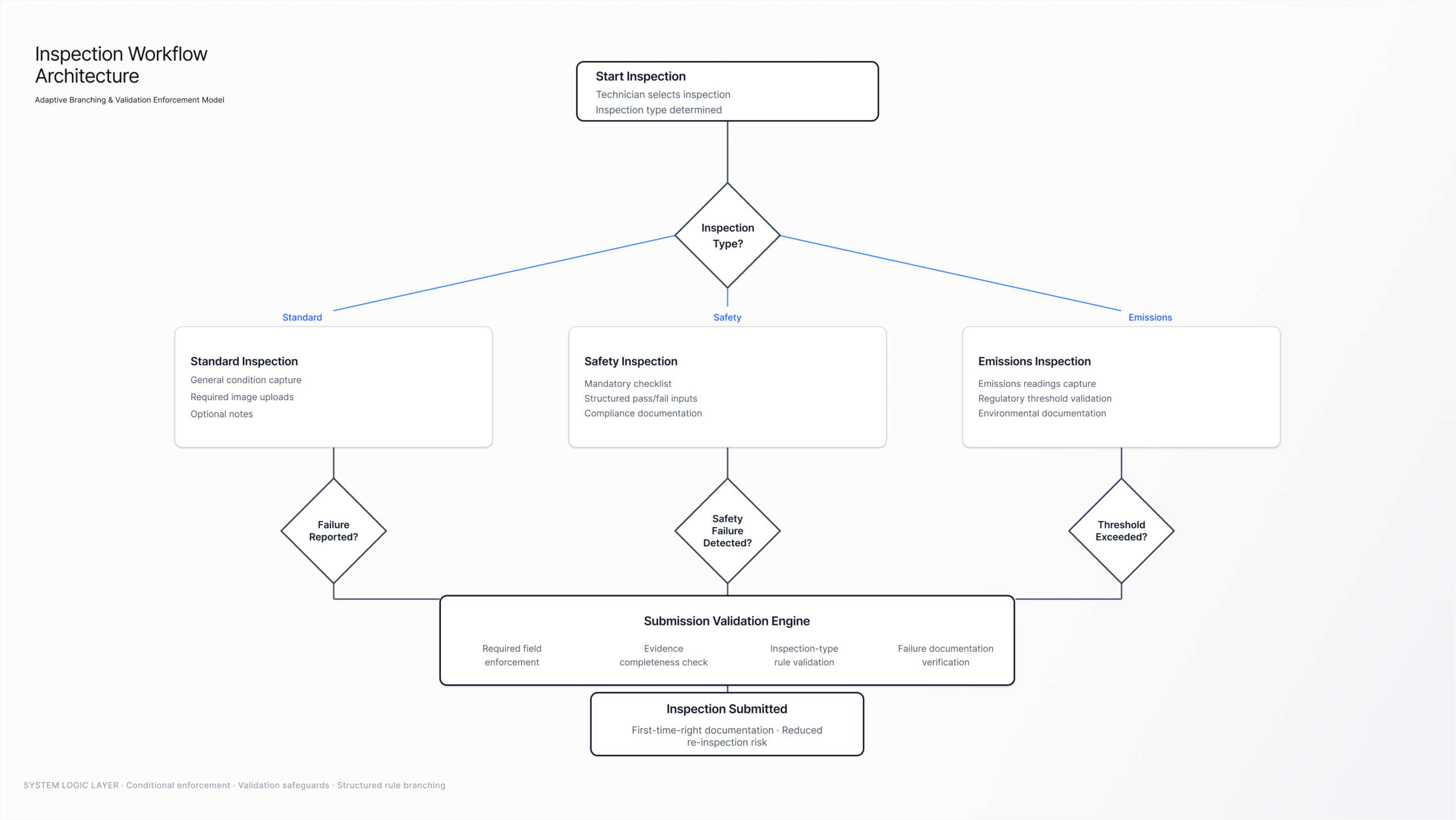
To standardize inspections while supporting dynamic conditions, I designed an adaptive branching workflow.
Key principles:
- Inspection types drive required evidence capture
- Failure conditions dynamically alter required documentation
- Submission validation enforces completeness
- All paths converge into a structured validation engine before submission
This reduced ambiguity in inspection behavior and supported first-time-right documentation, lowering rework and re-inspection risk.
Strategy: Design the Logic First
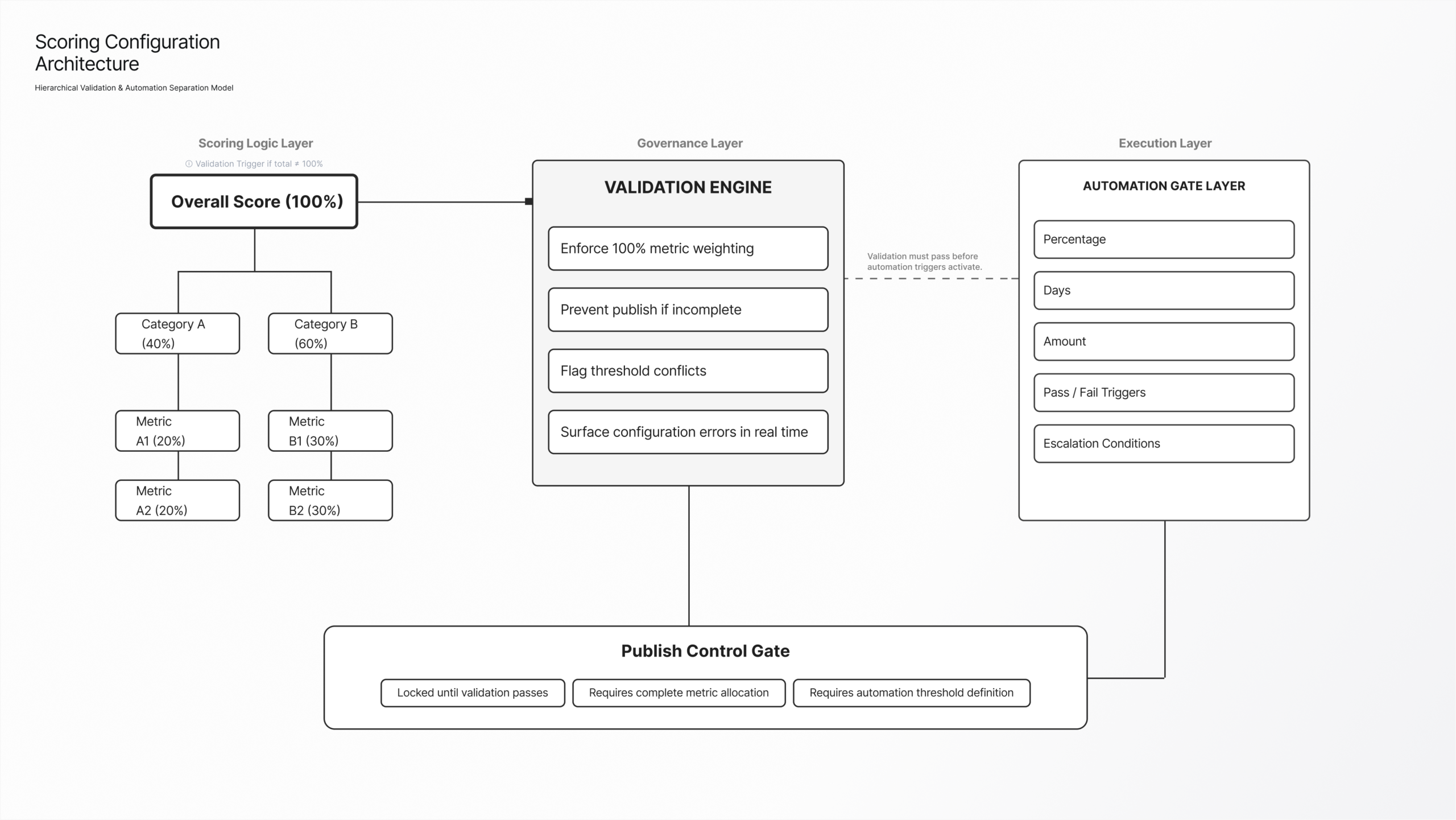
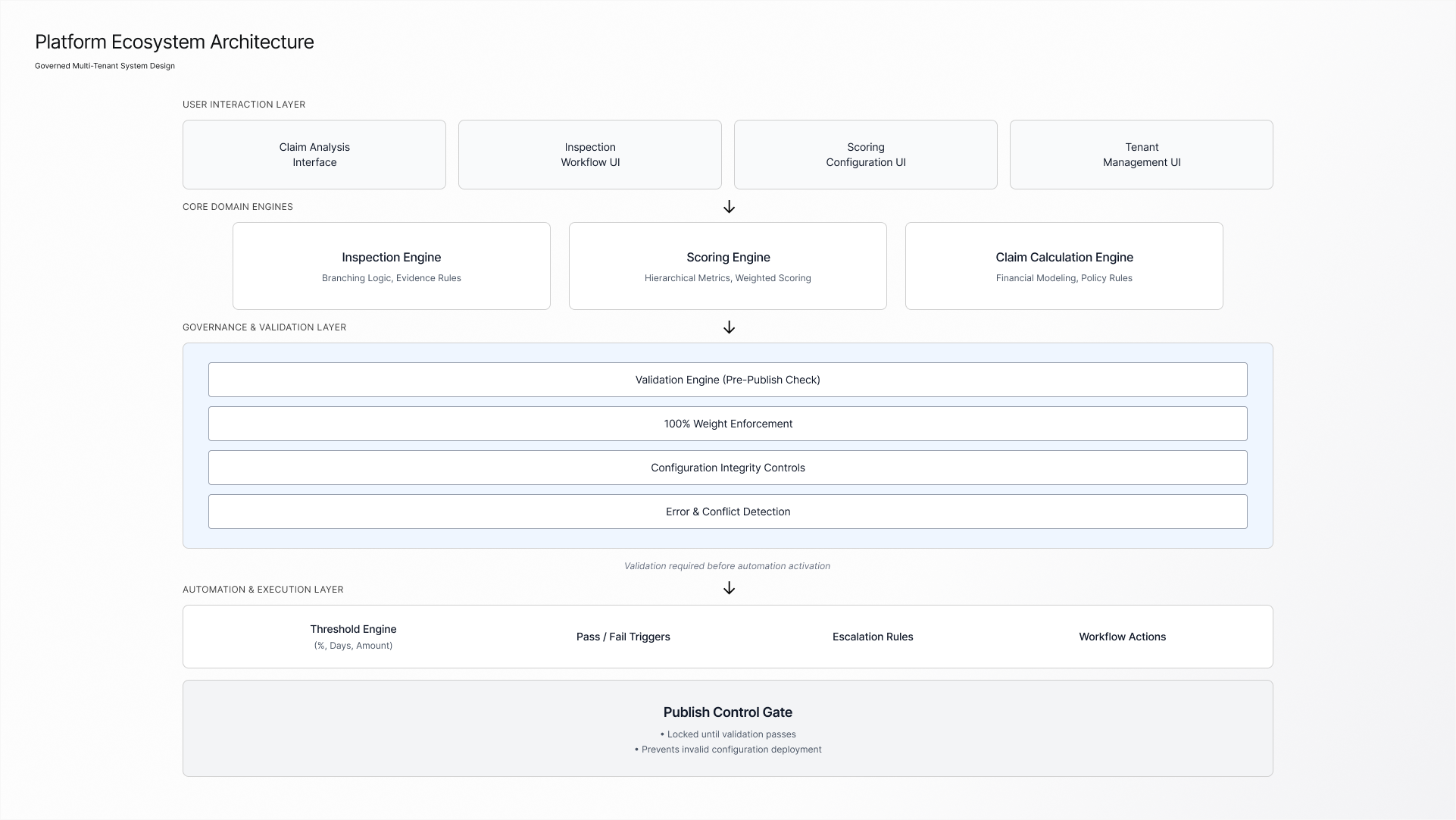
Before designing UI, I structured the system architecture. I separated the problem into three governed layers:
1. Separate Logic Layers
- Hierarchical metric grouping
- Enforced 100% weighting at every parent level
- Clear metric-to-category relationships
2. Validation Engine (Pre-Publish Check)
- Prevent publish if weighting ≠ 100%
- Surface configuration conflicts in real time
- Block incomplete scoring models
3. Automation Gate Layer
- Threshold types: Percentage, Days, Amount
- Pass/Fail triggers
- Escalation conditions
North Star:
Critically, automation was decoupled from scoring logic. Validation must pass before automation activates. This separation protected system integrity and reduced unintended behavior during configuration changes.
Execution Reality
Product direction often began as high-level conceptual input.
My role was to:
- Translate strategic product direction into structured system models
- Identify coupling risks early
- Prevent governance logic from being embedded directly into feature logic
- Guide engineering through implementation trade-offs
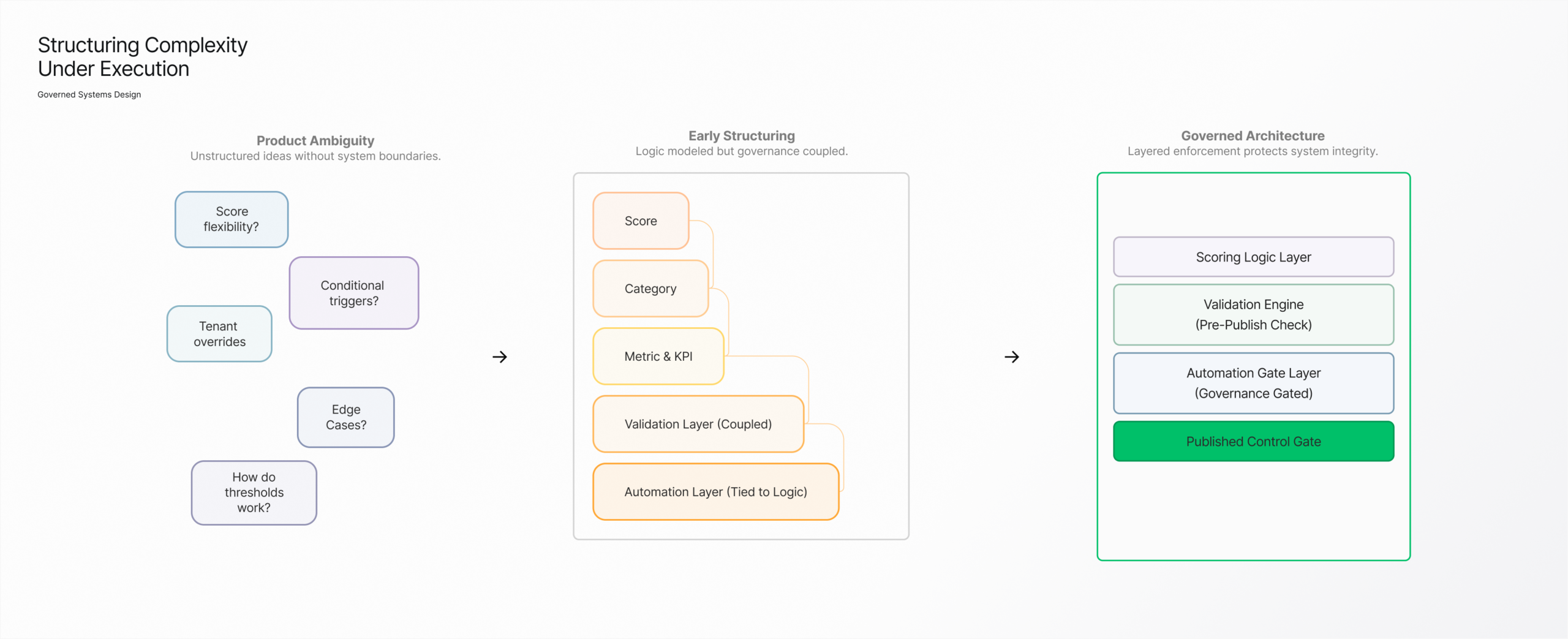
Through iteration, the system evolved from:
Unstructured feature ideas
→Coupled logic layers
→ Governed, decoupled architecture
This reduced implementation drift and improved clarity during sprint execution.
Without separating validation from automation, we would have embedded governance directly into scoring logic, creating long-term brittleness. By decoupling these layers early, we reduced engineering rework and preserved system extensibility.
The Solution Ecosystem
The final system supported:
Virtual Inspection Agent
- Standardized inspection flows
- Conditional branching logic
- Evidence enforcement
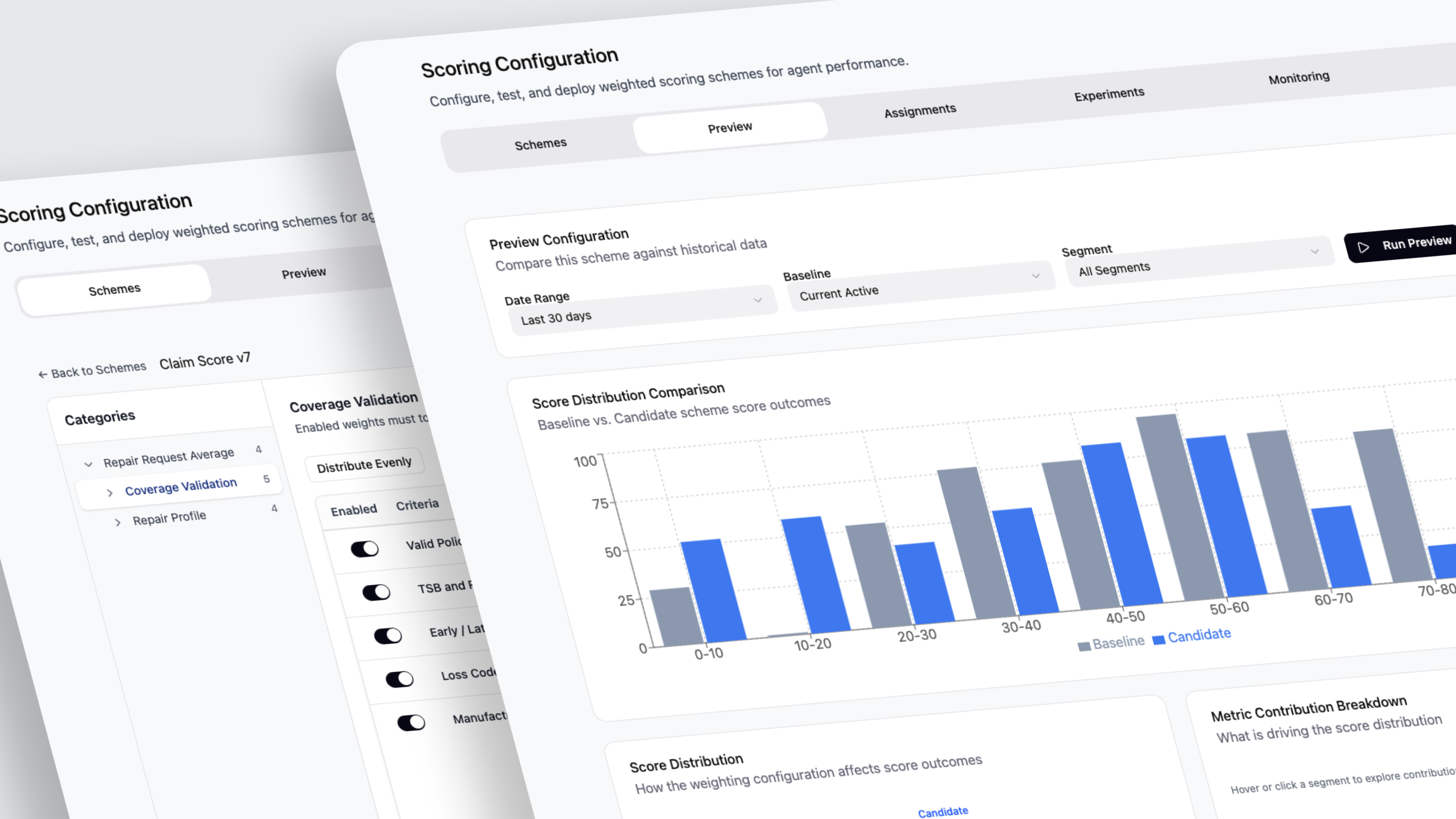
Scoring Configuration
- Structured metric hierarchies
- Enforced weighting validation
- Configurable automation thresholds
Tenant & Agent Management
- Multi-tenant configuration models
- Role-based access logic
- Controlled publish states
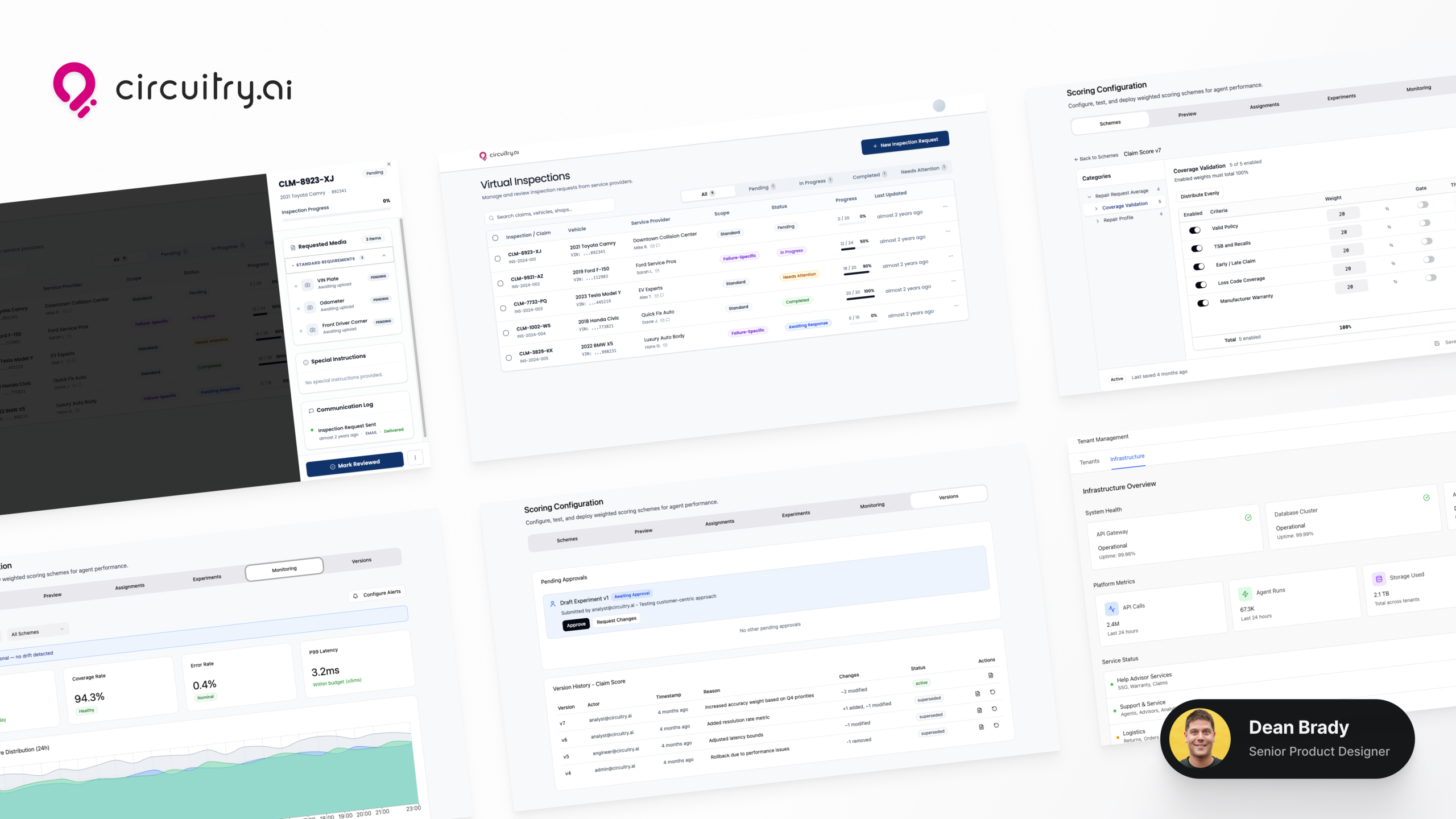
The platform evolved into a modular inspection, scoring, and automation ecosystem spanning configuration, analysis, and enforcement layers.
Impact
The final ecosystem included:
Operational Impact
- Reduced re-inspections by 33%
- Lowered dispatch costs by 11%
- Improved first-time-right documentation accuracy by 16%
System Impact
- Introduced enforced 100% metric validation across tenants
- Prevented invalid automation publishing at configuration layer
- Standardized enterprise configuration model
Organizational Impact
- Sole designer supporting 20+ engineers
- Defined architecture before implementation
- Established structured design-to-dev governance checkpoints